


About Caterina by Moonlight

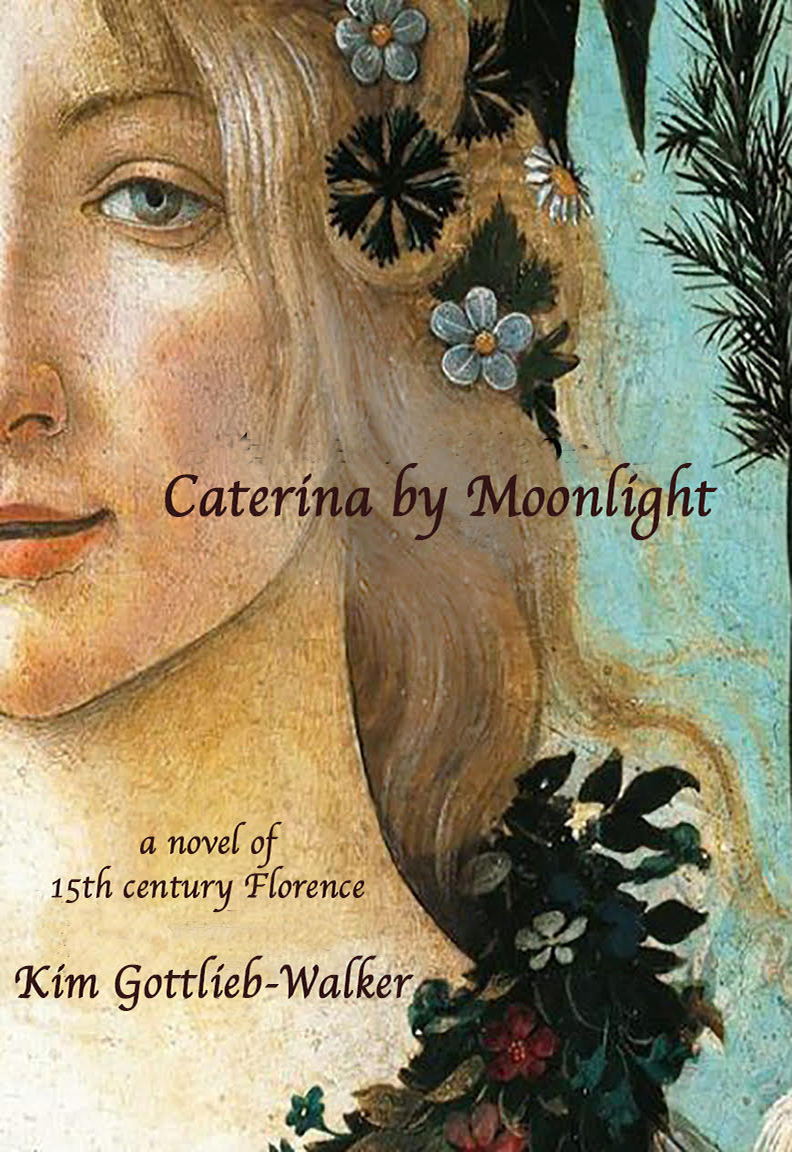
I spent three weeks in Florence, Italy, in Oct 2019, just before the covid plague spread across the world. I fell in love with the city and its history. I found my characters in Botticelli's paintings at the Uffizi Gallery, the largest collection of renaissance art in the world. When I got home to Laurel Canyon, I immersed myself in the history of the late 15th century - the rise of the Medici family, the Pazzi conspiracy, the "Cousins War" in England - and my characters dictated the story to me - Lorenzo and Giuliano de Medici, Lucretia Donati, and my heroine, Caterina. Sandro Botticelli was kind enough to design my cover.
If you love renaissance art, check out the online lectures offered by the brilliant art history professors Rocky Ruggiero (https://rockyruggiero.com/upcoming-webinars-events/) and Elaine Ruffolo (https://www.elaineruffolo.com/)...I learn something new every time.
Caterina by Moonlight is not yet published
but has already advanced to the semi-finals of the
Chanticleer CHAUCER AWARDS for pre-1750 historical fiction!
Rave Review of Caterina by Moonlight
from the Literary Titan Awards
Caterina by Moonlight is a historical novel that feels most alive when it stays close to Caterina’s own senses: the smell of herbs in the convent infirmary, the shimmer of painted robes, the noise of Florence’s streets, and the constant pull between obedience and curiosity. The book begins with a child being left at Le Murate and grows outward from that wound, following her into marriage, court life, political violence, travel, and eventual self-possession. What struck me most is that this isn’t just a Renaissance backdrop with costumes pinned onto it. It’s a coming-of-age story built out of religion, class, art, gender, and survival. From the start, the novel gives Caterina a clear emotional center, and that makes the long historical sweep easy to stay inside.
What the book does especially well is make Renaissance Florence feel inhabited rather than displayed. Author Kim Gottlieb-Walker fills the novel with workshops, convent routines, carnival songs, court spectacles, paintings, bargaining, spices, horses, manuscripts, and public ceremony. The detail rarely reads like research being shown off for its own sake. Instead, it becomes the medium through which Caterina understands the world. A tiny moment like the market pastry, when “It tasted like heaven,” says a lot about the novel’s method: history arrives through appetite, wonder, and bodily experience, not through lecture. That grounded sensory approach gives the book a warm pulse even when the plot turns dark.
Caterina herself is the reason the novel holds together over so many years and events. As a narrator, she begins with a child’s literal-minded innocence, then gradually becomes sharper, sadder, more observant, and more self-directed. The best parts of the book come from watching her mind at work as she absorbs contradictory lessons about holiness, beauty, marriage, desire, and duty. She doesn’t arrive as a ready-made heroine. She becomes one by learning how power actually works, then finding ways to move within it. That development gives the novel its shape. Even when the story leans into romance or court intrigue, it still feels like Caterina’s education in how to live inside her era without surrendering her inner life.
The novel is also deeply interested in women’s lives as networks of constraint, improvisation, and mutual recognition. Convent women, noblewomen, servants, mothers, lovers, and widows all occupy the book differently, and the story pays attention to the bargains each of them has to make. That gives the narrative some real heft. The historical figures and events, from Medici politics to foreign courts, matter here, but they matter because of how they shape private lives. By the time the book reaches its final movement, it has become a story not only about one woman’s endurance, but about how intelligence, memory, and affection can slowly create a life that feels chosen. When Matteo says, “Here begins a new life,” the line lands because the novel has earned it through hundreds of pages of loss, risk, and persistence.
Caterina by Moonlight is an immersive, character-centered historical novel with a generous heart and a strong sense of place. It’s interested in art, faith, politics, love, and danger, but it keeps returning to the same central question: what kind of self can a woman build when so much of her life is arranged by others? The answer the book gives is hopeful without feeling flimsy. It believes that knowledge matters, that pleasure matters, that loyalty matters, and that a life can widen even after it’s been narrowed. I came away feeling that the novel’s real subject is not simply Renaissance Florence, but the making of a woman who learns to see the world clearly and still choose joy inside it.
Rating: 5 out of 5
Thank you,
Thomas Anderson
Editor In Chief
Comments